Tuesday, May 26, 2015
Box and Whisker Graphs...or Box Plots!
Today we discussed Box and Whisker Graphs (also called Box Plots). Check out the resource on the back of the homework or this lesson and video for more information. Please note that the minimum can also be called the lower extreme and the maximum can also be called the upper extreme.

Tuesday, May 19, 2015
Summer Math
If you are interested in a free Summer Math packet for students going into 7th grade, please see the email that was sent home this week. There was also a note in Friday Folders a little while back. Contact Mrs. Springer via email if you have any questions. You may request a packet by turning in the form or by emailing Mrs. Springer. Thank you!
Monday, May 18, 2015
Hands On Algebra Continues!
We continued with new Hands On Algebra lessons today! We will have a new lesson on Tuesday and a review day Wednesday. There will be a test over Hands On Algebra on Thursday. Students are preparing for the test as they work in class Monday-Wednesday. Sixth graders will be able to use the pieces for the test on Thursday. :)
Tuesday, May 5, 2015
Quiz on Wednesay
We will have a Hands On Algebra Quiz on Wednesday! Students have already prepared for the quiz by doing their daily classwork. :)
Tuesday, April 28, 2015
Hands On Algebra
We started our Hands On Algebra (HOA) unit in class yesterday. This is a unit where students will build equations and solve them. On Monday we reviewed what students learned last year. Today we introduced (to some it was a review) the white pawn and discussed the idea of white and blue pawns (also called "x" and "star" are opposites).
HOA work is done at school. The kits do not go home. If students need extra time to finish daily work, we will arrange for that to happen at school. Here is a website to check out if you'd like more information.
HOA work is done at school. The kits do not go home. If students need extra time to finish daily work, we will arrange for that to happen at school. Here is a website to check out if you'd like more information.
Sunday, April 26, 2015
Survey for 6K
If you have time on Monday, students of 6K click here for the survey. Thanks!
Also, here are the links about the United Nations we will discuss in class on Monday.
United Nations Website
Washington Post Article
Also, here are the links about the United Nations we will discuss in class on Monday.
United Nations Website
Washington Post Article
Thursday, April 23, 2015
Science Challenge Night
Science Challenge Night will take place at the Middle School tonight from 5-8pm. Come on out and see all the great Science projects!
Tuesday, April 21, 2015
Math Workshop & Test Thursday
We will have Math Workshop Tuesday and Wednesday in class. The activities in Math Workshop will help students review and prepare for the Geometry Test on Thursday. Students will have a review packet for homework on Tuesday. Then, on Wednesday they will get a review page (with answers) and their graded packet that they can use to study for the test on Thursday. If you have any questions, please contact Mrs. Springer.
Monday, April 20, 2015
Surface Area Investigations
Today students continued some investigations with surface area. We made a rectangular prism from a net and found the surface area of the figure. Then we found the surface area of a 3D object drawn out. Check out this link if you would like a review of finding the surface area of a rectangular prism.
Friday, April 17, 2015
Wednesday, April 15, 2015
3D Shapes: Nets, Faces, Vertices, & Edges
Here is the link we will explore in Math class on Thursday!
Monday, April 13, 2015
Exploring Volume
Today we explored volume more! The sixth graders did an awesome job drawing conclusions about three rectangular prisms with the same base area. Check out a screenshot of our discussion for today. Ask your child what conclusion he/she found the most interesting!

Sunday, April 12, 2015
Finding Volume
On Friday students investigated how to find the volume of a rectangular prism. If they already knew the formula, sixth graders were asked to prove why it worked! Students were given a box and asked how many cubes would fit in the box. Some students took the l x w x h to find an answer. Another popular strategy was to take the area of the base and then multiply that by the height. Here is a snapshot of our conversations from one math class where a student was explaining that once her group found the area of one "layer", they could multiply that by how many total layers could fit in the box.

Wednesday, April 8, 2015
Quiz on Thursday!
Today we reviewed for our Area quiz tomorrow! All students have a review packet from our in class activity that we graded at the end of class. If you have any questions, please contact Mrs. Springer. The quiz is Thursday!
Tuesday, April 7, 2015
Trapezoid Tuesday
We started class off with a review and extension of Friday's lesson. Students were asked to find the area of the wall that needs to be painted (windows and the door did not need to be painted!). Most students chose to find the area of the whole wall (12 x 8 = 96) and then subtract the windows (2 x 2 = 4, then there are 2 total, for 8) and the door (3 x 6 = 18). The total area was 70ft2.
 Then we continued on with an investigation of trapezoids for our TRAPEZOID TUESDAY! :)
Looking at a trapezoid, students came up with the idea that we could divide the trapezoid into two triangles and then add the areas of the triangles. We also came up with the formula of (b + B) x h and then divide by 2.
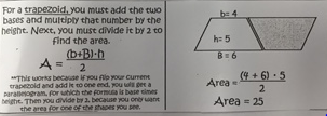

Looking at a trapezoid, students came up with the idea that we could divide the trapezoid into two triangles and then add the areas of the triangles. We also came up with the formula of (b + B) x h and then divide by 2.
There will be an area quiz on Thursday!
Thursday, April 2, 2015
Area of Triangles
Today we had a triangle investigation day! Students were given an acute, right, and obtuse triangle and they proved that the area of a triangle is always half of the area of a rectangle formed by the base and height of that triangle. It was quite the day filled with measurement and math! On Friday we will tackle different shapes there we can "chunk" or "carve" out rectangles and triangles to make the shape. For example, when given the shape below, students can make several rectangles to find the area.

Social Studies Webquest
Here is the link for the Social Studies webquest after your Daily Geography Quiz today. Enjoy!
Wednesday, April 1, 2015
Today's Triangle Investigation
Yesterday we worked with finding the are of right triangles. Students noticed that two right triangles made a rectangle, so they came to the conclusion you could multiply the base times the height of the right triangle and then divide by two (since the base times the height gives you the area of the quadrilateral...but each triangle only takes up half of the quadrilateral). Our formula for finding the area of a right triangle looked something like (b x h)/ 2 or
1/2 x b x h
Today students looked into acute triangles. We found two different ways to find the area of acute triangles. Take a look at the example below.
 One way would be to look at it as two right triangles (since we already know how to find the area of those!). You could find the area of the triangle with the base of 34m and height of 32m...take 32 x 34 / 2 or 1/2 x 32 x 34. The area of that right triangle is 544m2 (the last 2 should be an exponent!). Then the area of the other right triangle is 736m2. So, add that together to get 464 square meters for the area of the whole triangle.
Another way to look at it is that we discovered that two acute triangles make a parallelogram. So, we can take the height ( not a side measurement!) and multiply it by the whole base, and then divide by two. So, we could do 32 x (34 + 12) /2 or 1/2 x 46 x 32..so 736 square meters.
1/2 x b x h
Today students looked into acute triangles. We found two different ways to find the area of acute triangles. Take a look at the example below.
Another way to look at it is that we discovered that two acute triangles make a parallelogram. So, we can take the height ( not a side measurement!) and multiply it by the whole base, and then divide by two. So, we could do 32 x (34 + 12) /2 or 1/2 x 46 x 32..so 736 square meters.
Tuesday, March 31, 2015
Daily Geography Quiz Thursday!
We have started Week 12 of Daily Geography! Yesterday we studied a map of ORD Airport and today we discussed traveling within the airport at more length. On Thursday we will play a Kahoot! game and have our Daily Geography Quiz for the week.
Monday, March 30, 2015
Geometry Unit
We are starting our Geometry Unit today --- wahoo! And, we are trying to incorporate some Geometry jokes into the lesson in hopes to capture student interest. :)
Today students investigated parallelograms and found a way that we could always find the area of a parallelogram. Some students had the idea to divide the shape into two triangles and a rectangle and then find the area of the two triangles and add it to the area of the rectangle. Other students discovered that if we cut off one triangle we could move it to the other end and make a rectangle; this way we could just take "base x height" to find the area of any parallelogram. Check out the image below!

We started a notes page that should be inside each student's math resource folder. Check it out periodically to see what we are learning during this unit! Here is a snapshot with the same information as the notes students got today.
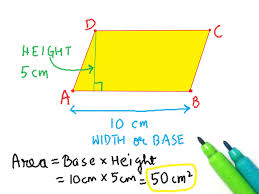
Today students investigated parallelograms and found a way that we could always find the area of a parallelogram. Some students had the idea to divide the shape into two triangles and a rectangle and then find the area of the two triangles and add it to the area of the rectangle. Other students discovered that if we cut off one triangle we could move it to the other end and make a rectangle; this way we could just take "base x height" to find the area of any parallelogram. Check out the image below!
We started a notes page that should be inside each student's math resource folder. Check it out periodically to see what we are learning during this unit! Here is a snapshot with the same information as the notes students got today.
Subscribe to:
Posts (Atom)