
Sunday, April 12, 2015
Finding Volume
On Friday students investigated how to find the volume of a rectangular prism. If they already knew the formula, sixth graders were asked to prove why it worked! Students were given a box and asked how many cubes would fit in the box. Some students took the l x w x h to find an answer. Another popular strategy was to take the area of the base and then multiply that by the height. Here is a snapshot of our conversations from one math class where a student was explaining that once her group found the area of one "layer", they could multiply that by how many total layers could fit in the box.

Wednesday, April 8, 2015
Quiz on Thursday!
Today we reviewed for our Area quiz tomorrow! All students have a review packet from our in class activity that we graded at the end of class. If you have any questions, please contact Mrs. Springer. The quiz is Thursday!
Tuesday, April 7, 2015
Trapezoid Tuesday
We started class off with a review and extension of Friday's lesson. Students were asked to find the area of the wall that needs to be painted (windows and the door did not need to be painted!). Most students chose to find the area of the whole wall (12 x 8 = 96) and then subtract the windows (2 x 2 = 4, then there are 2 total, for 8) and the door (3 x 6 = 18). The total area was 70ft2.
 Then we continued on with an investigation of trapezoids for our TRAPEZOID TUESDAY! :)
Looking at a trapezoid, students came up with the idea that we could divide the trapezoid into two triangles and then add the areas of the triangles. We also came up with the formula of (b + B) x h and then divide by 2.
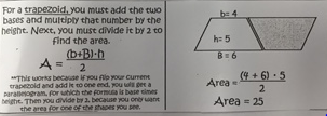

Looking at a trapezoid, students came up with the idea that we could divide the trapezoid into two triangles and then add the areas of the triangles. We also came up with the formula of (b + B) x h and then divide by 2.
There will be an area quiz on Thursday!
Thursday, April 2, 2015
Area of Triangles
Today we had a triangle investigation day! Students were given an acute, right, and obtuse triangle and they proved that the area of a triangle is always half of the area of a rectangle formed by the base and height of that triangle. It was quite the day filled with measurement and math! On Friday we will tackle different shapes there we can "chunk" or "carve" out rectangles and triangles to make the shape. For example, when given the shape below, students can make several rectangles to find the area.

Social Studies Webquest
Here is the link for the Social Studies webquest after your Daily Geography Quiz today. Enjoy!
Wednesday, April 1, 2015
Today's Triangle Investigation
Yesterday we worked with finding the are of right triangles. Students noticed that two right triangles made a rectangle, so they came to the conclusion you could multiply the base times the height of the right triangle and then divide by two (since the base times the height gives you the area of the quadrilateral...but each triangle only takes up half of the quadrilateral). Our formula for finding the area of a right triangle looked something like (b x h)/ 2 or
1/2 x b x h
Today students looked into acute triangles. We found two different ways to find the area of acute triangles. Take a look at the example below.
 One way would be to look at it as two right triangles (since we already know how to find the area of those!). You could find the area of the triangle with the base of 34m and height of 32m...take 32 x 34 / 2 or 1/2 x 32 x 34. The area of that right triangle is 544m2 (the last 2 should be an exponent!). Then the area of the other right triangle is 736m2. So, add that together to get 464 square meters for the area of the whole triangle.
Another way to look at it is that we discovered that two acute triangles make a parallelogram. So, we can take the height ( not a side measurement!) and multiply it by the whole base, and then divide by two. So, we could do 32 x (34 + 12) /2 or 1/2 x 46 x 32..so 736 square meters.
1/2 x b x h
Today students looked into acute triangles. We found two different ways to find the area of acute triangles. Take a look at the example below.
Another way to look at it is that we discovered that two acute triangles make a parallelogram. So, we can take the height ( not a side measurement!) and multiply it by the whole base, and then divide by two. So, we could do 32 x (34 + 12) /2 or 1/2 x 46 x 32..so 736 square meters.
Tuesday, March 31, 2015
Daily Geography Quiz Thursday!
We have started Week 12 of Daily Geography! Yesterday we studied a map of ORD Airport and today we discussed traveling within the airport at more length. On Thursday we will play a Kahoot! game and have our Daily Geography Quiz for the week.
Subscribe to:
Posts (Atom)